
In this article
- Understanding Liquid Ring Vacuum Pump Technology
- How Does a Liquid Ring Vacuum Pump Work?
- Key Advantages of Liquid Ring Vacuum Pumps in Industrial Applications
- Industrial Applications of Liquid Ring Vacuum Pumps
- SWAM Liquid Ring Vacuum Pumps: Engineered for Industrial Performance
- Important Factors When Selecting a Liquid Ring Vacuum Pump
- Maintaining Reliable Performance Over Time
- The Role of Liquid Ring Vacuum Technology in Modern Industry
- Conclusion
Industrial operations often involve complex processes that require consistent vacuum generation under challenging operating conditions. From chemical processing and oil refineries to power generation and pulp manufacturing, maintaining a stable vacuum is essential for process efficiency, equipment reliability, and uninterrupted production.
However, industrial environments frequently expose vacuum equipment to moisture, vapours, fluctuating temperatures, and process contaminants. Conventional vacuum technologies may face limitations when handling such conditions, making equipment selection particularly important.
Liquid Ring Vacuum Pumps (LRVPs) provide a practical solution for applications involving wet gases, condensable vapours, and continuous vacuum requirements. Their straightforward operating principle, robust construction, and ability to handle demanding process conditions make them widely used across industrial sectors.
With decades of engineering expertise, SWAM offers Liquid Ring Vacuum Pumps designed to deliver reliable performance across a range of industrial applications.
Understanding Liquid Ring Vacuum Pump Technology
A Liquid Ring Vacuum Pump is a rotary positive-displacement machine that uses a liquid, typically water, to generate vacuum and compress gases.
Unlike conventional mechanical compression systems that depend primarily on direct contact between moving components, liquid ring technology uses a rotating liquid ring as the sealing and compression medium.
The pump consists of a cylindrical casing containing an eccentrically positioned rotor fitted with radial blades. When the rotor rotates, centrifugal force causes the sealing liquid to form a ring along the inner surface of the casing.
Because the rotor is positioned eccentrically, the spaces between the blades and liquid ring change in volume throughout each rotation. This variation creates the suction, compression, and discharge cycles necessary for vacuum generation.
The liquid also assists in removing heat generated during compression, making the technology particularly suitable for applications involving saturated gases and condensable vapours.
How Does a Liquid Ring Vacuum Pump Work?
The working principle of a Liquid Ring Vacuum Pump involves three essential stages.
1. Liquid Ring Formation
When the rotor begins rotating, centrifugal force pushes the sealing liquid outward against the pump casing. This creates a continuous liquid ring around the rotor.
The eccentric positioning of the rotor results in varying chamber volumes between its blades and the liquid ring.
2. Suction and Gas Intake
As the rotor turns, the volume between adjacent blades and the liquid ring increases.
This creates a low-pressure region that draws gas or vapour into the pump through the suction port.
The liquid ring maintains the seal between the chambers, allowing the pump to develop and sustain the required vacuum.
3. Compression and Discharge
As rotation continues, the chamber volume gradually decreases.
The trapped gas is compressed and subsequently discharged through the outlet port.
This continuous operating cycle enables Liquid Ring Vacuum Pumps to provide steady vacuum generation for industrial processes.
One of the most significant advantages of this mechanism is its ability to accommodate moisture and condensable vapours without relying on oil as the compression medium.
Key Advantages of Liquid Ring Vacuum Pumps in Industrial Applications
1. Reliable Operation in Wet and Harsh Environments
Industrial processes frequently involve moisture-laden gases, steam, condensable vapours, and occasional liquid carryover.
Liquid Ring Vacuum Pumps are particularly suitable for these conditions because liquid is already an integral part of their operating mechanism.
Their ability to handle wet gas streams and limited liquid or particulate slugs makes them valuable in chemical processing, power generation, and other demanding industrial applications.
2. Near-Isothermal Compression
Compression in a Liquid Ring Vacuum Pump occurs in close contact with the sealing liquid.
The liquid absorbs a significant portion of the heat generated during compression, helping maintain relatively stable operating temperatures.
This near-isothermal compression characteristic can be beneficial when handling temperature-sensitive gases and vapours, subject to the suitability of the selected seal liquid and operating conditions.
3. Smooth and Low-Vibration Operation
Continuous industrial processes require equipment that operates consistently without excessive vibration or mechanical disturbances.
Liquid Ring Vacuum Pumps provide smooth gas compression through the movement of the liquid ring.
Their operating characteristics can contribute to reduced vibration and noise levels, supporting a more stable industrial working environment.
4. Oil-Free Compression Chamber
In applications where oil contamination must be avoided, Liquid Ring Vacuum Pumps offer an important operational advantage.
Because the liquid ring acts as the compression and sealing medium, the pumping chamber does not require lubricating oil.
This feature makes the technology useful in processes where maintaining gas-stream cleanliness is important. However, appropriate management of the sealing liquid remains essential, particularly when handling hazardous or contaminated gases.
5. Flexible Material and Configuration Options
Industrial operating conditions vary significantly depending on the process medium, temperature, pressure, and potential exposure to corrosive substances.
Liquid Ring Vacuum Pumps can be manufactured using different materials and sealing arrangements to match specific requirements.
Selecting appropriate construction materials helps address corrosion, erosion, and compatibility concerns, improving equipment suitability for demanding process environments.
6. Simplified Maintenance Requirements
A well-designed Liquid Ring Vacuum Pump features a relatively straightforward compression mechanism.
Because the liquid acts as the sealing medium, there is no requirement for mechanical contact between the rotor blades and pump casing during normal operation.
This design can reduce certain forms of internal wear and simplify maintenance compared with technologies that use contacting compression elements.
Nevertheless, regular inspection of bearings, seals, liquid quality, and operating parameters remains essential for dependable performance.
Industrial Applications of Liquid Ring Vacuum Pumps
The versatility of liquid ring technology makes it suitable for various industries requiring vacuum generation under challenging operating conditions.
Oil and Gas Industry
Oil and gas processing facilities frequently require vacuum systems for handling hydrocarbon vapours, process gases, and moisture-containing streams.
Liquid Ring Vacuum Pumps can support applications associated with refining, gas processing, and petrochemical operations.
Their suitability for handling wet gas streams makes them particularly valuable where condensation may occur during vacuum generation.
Chemical Processing Plants
Chemical manufacturing involves a wide variety of process conditions, including corrosive vapours, solvent-containing gases, and moisture-rich environments.
Liquid Ring Vacuum Pumps are used in vacuum distillation, evaporation, filtration, and other chemical processing applications.
Appropriate material selection and compatible sealing liquids are essential when dealing with aggressive chemicals.
Pulp and Paper Industry
Vacuum systems play an important role in paper manufacturing, particularly during sheet formation and water removal.
Liquid Ring Vacuum Pumps help generate the vacuum required for dewatering and related processes.
Their ability to operate in moisture-intensive environments makes them a suitable choice for many pulp and paper applications.
Power Generation Plants
Power plants use vacuum systems to support condenser operations and maintain efficient steam-cycle performance.
Liquid Ring Vacuum Pumps can be employed for air extraction and removal of non-condensable gases from condenser systems.
Maintaining the appropriate condenser vacuum is important for supporting turbine efficiency and consistent power generation.
Textile Industry
Textile manufacturing processes may require vacuum for moisture extraction, drying, and other production operations.
Liquid Ring Vacuum Pumps can provide dependable vacuum generation for suitable textile-processing applications.
Jet and Surface Condensers
Condenser systems require effective removal of air and non-condensable gases to maintain the desired operating pressure.
Liquid Ring Vacuum Pumps can support condenser evacuation and continuous air-removal duties, helping maintain stable vacuum conditions.
SWAM Liquid Ring Vacuum Pumps: Engineered for Industrial Performance
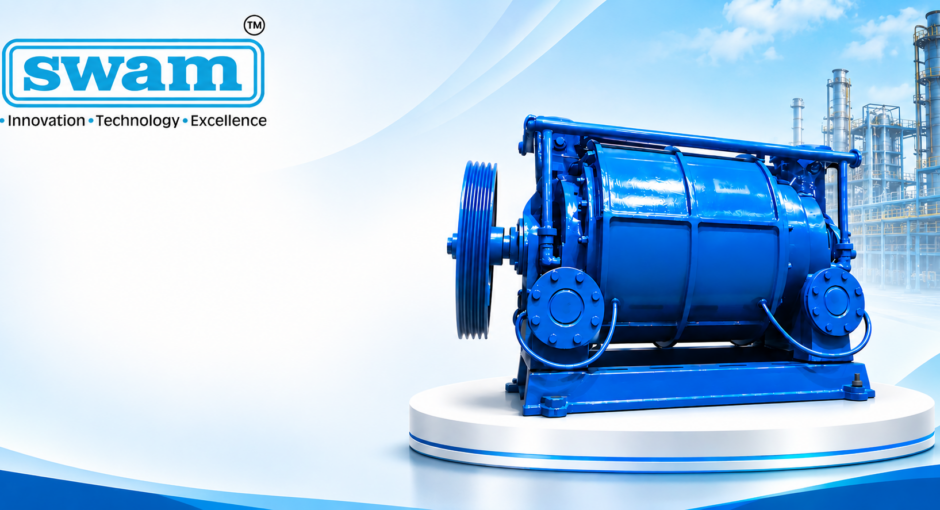
SWAM offers Liquid Ring Vacuum Pumps designed for industrial applications involving moisture, vapours, and challenging operating environments.
The product range includes various configurations to address different capacity requirements, operating conditions, and process needs.
According to SWAM’s published product specifications, its Liquid Ring Vacuum Pump range offers the following capabilities:
| Parameter | Published specification |
|---|---|
| Maximum Capacity | Up to 30,000 m³/hr |
| Vacuum Level | Up to 90% |
| Operating Technology | Water Ring |
| Design Options | API and Non-API |
| Referenced Design Standard | API 681 |
| Referenced Testing Standards | BS 1571 Part 2: 1975, Pneurop 6612, HEI |
The published capacity and vacuum figures represent range-level capabilities rather than specifications applicable to every individual model.
Available Product Configurations
SWAM provides multiple Liquid Ring Vacuum Pump series to accommodate different industrial requirements.
SVL/ SVLC – Single Stage Liquid Ring Vacuum Pumps and Compressors
Designed for applications requiring double-stage liquid ring technology, with multiple models offering different capacities and operating speeds.
SVLP – Chemical Series, Single Stage Plate Design
This series offers single-stage configurations for chemical and industrial vacuum applications.
SVLD – Chemical Series, Double Stage
Double-stage configurations developed for chemical process requirements, with a selection of models covering different operating capacities.
SVLC – Closed Coupled Series
Closed-coupled configurations provide additional equipment-selection options for applications with appropriate capacity and installation requirements.
Each series includes model-specific operating parameters such as motor power, rotational speed, pumping capacity, and seal-water requirements.
Important Factors When Selecting a Liquid Ring Vacuum Pump
Choosing the correct Liquid Ring Vacuum Pump requires careful evaluation of process conditions rather than focusing solely on maximum pumping capacity.
Required Vacuum Level
Different industrial applications require different operating pressures. The selected pump must achieve the desired vacuum under actual operating conditions.
Pumping Capacity
The required pumping capacity depends on the amount of gas or vapour that must be removed from the process.
Capacity should be evaluated at the specified suction pressure, temperature, and gas composition.
Seal Liquid Temperature and Quality
The sealing liquid has a direct influence on vacuum performance.
Higher seal-liquid temperatures can increase vapour pressure and limit the attainable vacuum. Liquid quality and chemical compatibility must also be considered.
Gas Composition and Process Conditions
The presence of corrosive gases, solvents, condensable vapours, or particulates can influence the selection of pump materials and sealing arrangements.
Energy and Water Consumption
Motor power and seal-liquid consumption are important factors in evaluating operating costs.
Depending on process requirements, suitable seal-liquid recirculation arrangements may help reduce fresh-water consumption.
Maintenance Accessibility
Easy access to seals, bearings, and other serviceable components can simplify maintenance activities and reduce downtime during planned servicing.
Evaluating these factors helps ensure the vacuum pump is appropriately matched to its intended industrial application.
Maintaining Reliable Performance Over Time
Even robust industrial vacuum equipment requires proper maintenance to sustain dependable operation.
Routine maintenance of Liquid Ring Vacuum Pumps should include:
Monitoring seal-liquid temperature, flow, and quality.
Inspecting mechanical seals, bearings, and associated components.
Checking suction pressure and discharge conditions.
Monitoring vibration and unusual operating noise.
Inspecting pipelines for restrictions, leakage, or blockage.
Verifying that the pump operates within its recommended performance range.
Following manufacturer-recommended maintenance schedules.
Proper operating practices and preventive maintenance help minimize unexpected interruptions, protect equipment components, and support consistent vacuum performance.
The Role of Liquid Ring Vacuum Technology in Modern Industry
As industrial facilities place increasing emphasis on process reliability, operational efficiency, and equipment lifecycle management, vacuum technology continues to play an important role in maintaining production performance.
Liquid Ring Vacuum Pumps remain relevant because of their established operating principle and ability to handle challenging gas streams.
Their suitability for moisture-rich environments, relatively stable compression temperatures, and flexible construction options makes them valuable across various process industries.
At the same time, efficient system design remains important. Proper pump sizing, seal-liquid management, energy evaluation, and preventive maintenance can significantly influence overall operating performance.
For industrial operators, selecting the appropriate vacuum technology is therefore not simply an equipment purchasing decision. It is an important part of maintaining consistent process conditions and long-term plant reliability.
Conclusion
Liquid Ring Vacuum Pumps provide a dependable vacuum solution for demanding industrial environments, particularly where moisture, condensable vapours, and continuous operating requirements present challenges.
Their liquid-based compression mechanism, near-isothermal operating characteristics, and ability to handle wet process streams make them suitable for applications across the chemical, oil and gas, pulp and paper, power generation, and textile industries.
With a broad range of configurations and published capacities of up to 30,000 m³/hr, SWAM offers Liquid Ring Vacuum Pump solutions for diverse industrial requirements.
By selecting the correct pump configuration, materials, operating parameters, and maintenance practices, industrial facilities can support reliable vacuum generation and consistent process performance.
To explore available configurations and technical specifications, visit SWAM Liquid Ring Vacuum Pumps
Explore SWAM Liquid Ring Vacuum Pumps
Review the available configurations and technical specifications on the official SWAM product page.
Technical specifications vary by model and operating conditions. Confirm requirements against the manufacturer’s published data before selection.